

A brief history of Omega
Omega was founded in 1848 by Louis Brandt and La Chaux-de-Fonds, Switzerland. This Swiss watchmaking company has deep roots in sports timekeeping such as being the official timekeeper for the Olympic Games since 1932 and iconic exploration endeavors like the Speedmaster on the Moon.
The Seamster Lineage
The Seamaster lineage was established in 1948 and has since been Omega’s longest-running line. It was launched to celebrate Omega’s 100th anniversary. The Seamaster Aqua Terra was introduced in 2002. As its Latin name suggests, ‘water’ and ‘land’ it is marketed as a more versatile and elegant sub-collection within the Seamaster family. It was designed to be the perfect all-rounder – sophisticated enough for formal occasions yet robust and water-resistant enough for an active lifestyle and maritime activities. Many see it as Omega’s answers to the Rolex Datejust or Explorer, offering a blend of sportiness and elegance.

What makes an Aqua Terra, an Aqua Terra?
- The “Teak Concept” Dial: Introduced around 2008, this became a defining feature of many Aqua Terra models. The dials feature horizontal engraved lines (the modern version) reminiscent of the wooden decks of luxury sailboats, reinforcing the nautical theme.
- Versatility: The Aqua Terra is known for its ability to seamlessly transition from a sports watch to a dress watch. The combination of a robust build, good water resistance, and refined aesthetics makes it suitable for almost any occasion.
- Focus on Legibility: Clear, applied hour markers and well-proportioned hands (often dauphine or arrow-shaped) ensure excellent readability.
- Co-axial Movement: The Aqua Terra collection was one of the early beneficiaries of Omega’s Co-Axial escapement technology that has been the stable movement for almost all modern Omega watches sold. The new escapement technology promises longer durability, less servicing needs, while maintaining and improving on the precision in timekeeping.
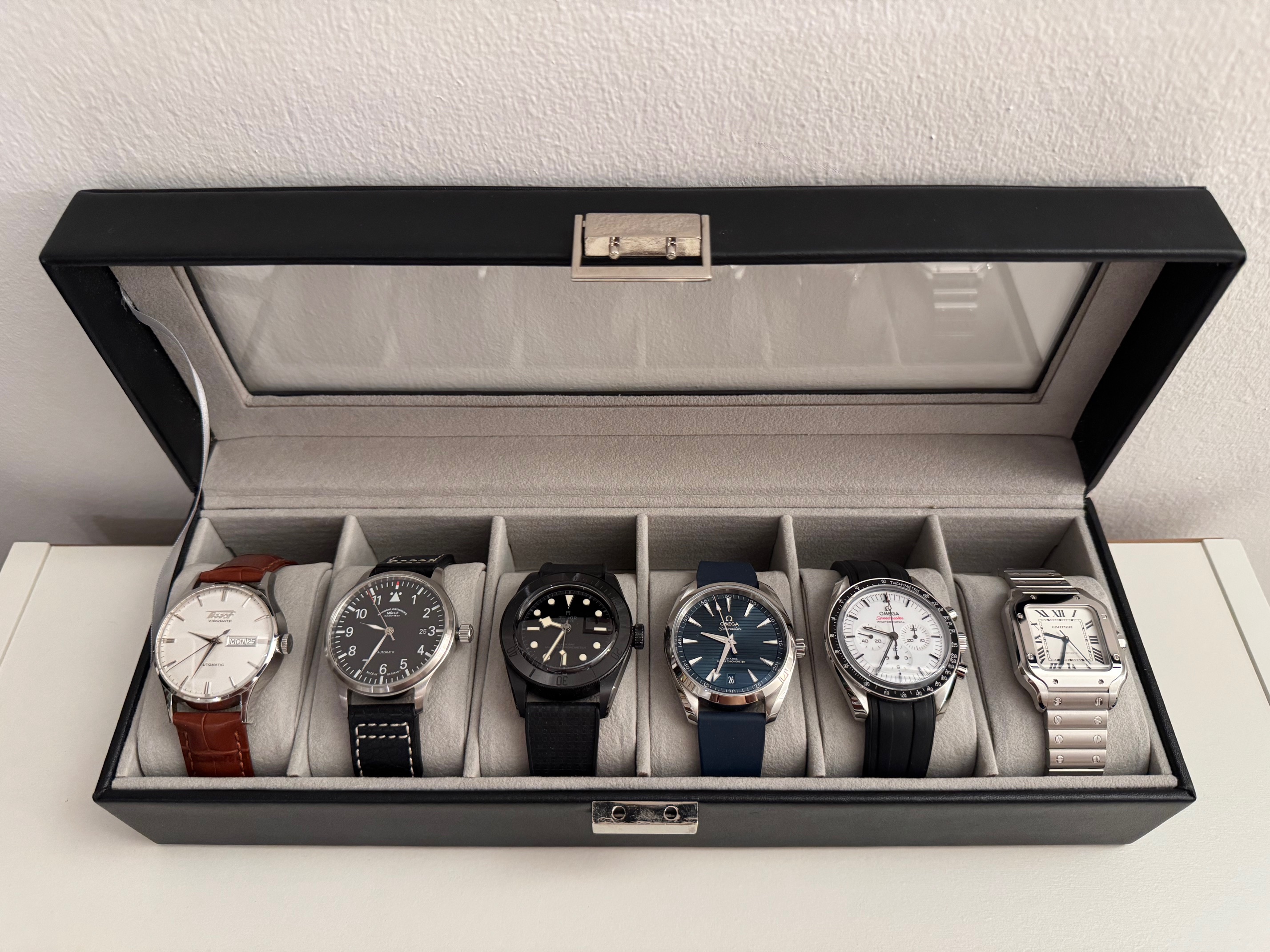
- Master Chronometer certified: Like my Tudor Black Bay Ceramic, most Omega watches are METAS certified and the Aqua Terra line of watches is no excecption.
Why I bought this watch
It has always been a dream of mine to own an Omega watch. While the blue dial version wasn’t by top choice, it was a safe one since blue is the most common colour when it comes to luxury watches. Back when I got my Tissot, one particular color scheme of the Aqua Terra caught my eye. It was a white dial with orange hands. Sadly it is no longer in production. The second one that caught my eye was was widely unavailable was the blue dial with yellow hands, commemorating the record breaker world vaulter Armand Duplantis at the Olympic games. But at that time it was newly released and most ADs weren’t carrying it when I was in the market for my first Omega. Thus, I had to settle of a similar version just the standard silver hands.
The exhibition case back was something to behold as well. Omega made beautiful looking timepieces that can be admire both from the outside and the movement inside as well, all without breaking the bank. The Aqua Terra is such a stable under Omega’s collection that you need to own at least one of the Aqua Terra watches. Omega has come a long way in release a wide variety of size, color and materials within Aqua Terra model. Till this day, despite its simplistic design, this is a go-anywhere, do-anything watch (GADA) suitable for any occasion outdoors and indoors.

 thecosmopolitanwanderer.blog
Leave a comment